
JOOLA Pro V Kosmos Review | Subtle Upgrade or Skip?
Price: $300
Discount Code: None available
Warranty: 12 months
Overview
JOOLA just dropped its fifth-generation paddle line, and the Kosmos is the one turning heads. It's a new hybrid shape, it's Fed Staksrud's first signature model, and it costs $300. So the question everybody's asking: is it actually better than the Pro IV, or just more expensive?
I've had time with this paddle both in the lab and on court. These are early impressions from my first hits series, not a final verdict. But I have enough data and enough reps to give you a real sense of what's going on here.
In this article:
What Changed from the Pro IV
Specs and Weight Profile
Performance Data and KewCOR
On-Court Feel
14mm vs. 16mm
Who It's For (and Who Should Skip It)
Final Verdict
Quick disclosure: JOOLA sent me this paddle for potential review. No money changed hands, and they had no input on this article. If you use my affiliate link, I do get a commission, but there are no discounts on this paddle
Build & Construction - What Changed?
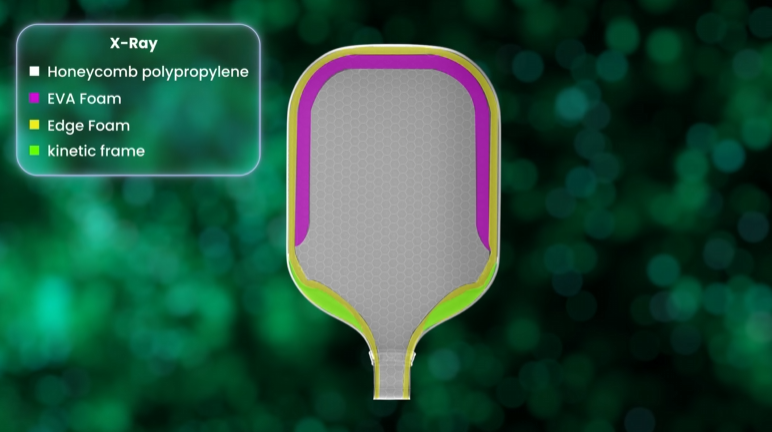
Let's zoom out first. The Pro V line is more of an iteration than a reinvention. Internally, most of the construction carries over from the Pro IV. You still have a polypropylene honeycomb core, a horseshoe-shaped EVA band around that core, and edge foam outside the EVA.
That's worth noting because much of the market has moved toward full foam cores. JOOLA is sticking with honeycomb.
The big change is in the neck. Instead of just foam inserts, JOOLA is using a carbon fiber frame surrounded by foam, which they're calling the "Kinetic Frame."
That frame actually thins out through the neck, allowing the paddle to flex more during impact. The idea is borrowed from hockey sticks and golf clubs, where flex and snapback influence energy transfer.
JOOLA claims this creates a more consistent launch angle off the face, and they've shown some high-speed footage that suggests there might be something there. I'll get into how it actually feels on court.
They also added a strip of carbon fiber near the top of the paddle between the EVA foam and the honeycomb core for reinforcement. There's a 12-month warranty, but this is still a honeycomb-based build, so core crushing remains a real possibility. If you got burned by Gen 3 durability issues, I'd hold off and wait to see how these hold up over time.
PADDLE SPECS
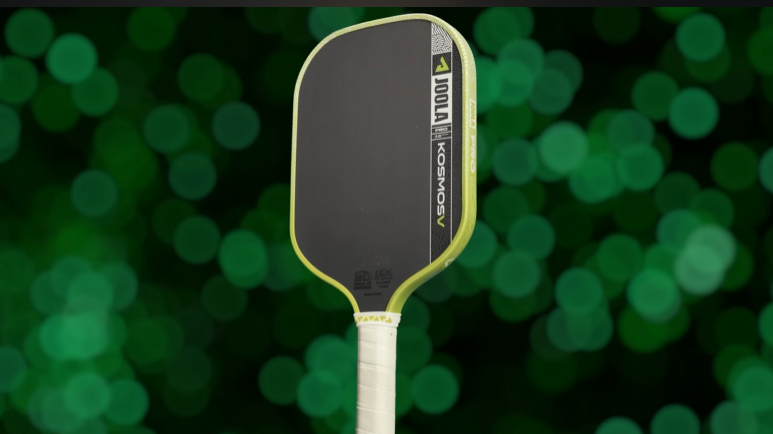
This paddle is $300, which puts it right at the top end of the market. There are no discount codes, but purchasing with my affiliate link does help support the channel.
The Kosmos is also a new shape for JOOLA. It's a hybrid, sitting right between the elongated Perseus and the widebody Scorpius. This is also Fed Staksrud's first signature model. I'm mainly testing the 16mm version here.
For the weight and balance, a few things stand out:
Static weight: 8.1 oz - Pretty average for a hybrid
Swing weight: 115.5 - Above average
Twist weight: 6.9 - Above average in the 75th percentile
Balance point: 24.4cm - Above average in the 63rd percentile
What that means in real terms: this paddle is going to feel a little bit heavier than typical for a hybrid, but also more stable on off-center shots.
PERFORMANCE METRICS
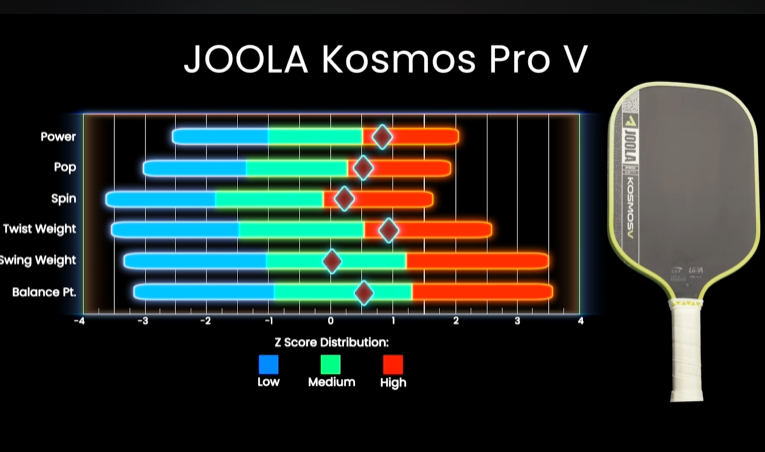
Overall, the paddle sits low in the power category, right near that boundary with all-court. From the z-scores above, you can see how it stacks up across the board:
- Firepower: Lands on the low end of high
- Pop: Comes in just a bit below that
- Spin: Also in that low-high range
- Twist weight: Follows a similar pattern, which is a nice sign for stability
- Swing weight: Sits pretty much right in the middle of medium
- Balance point: Toward the higher end of medium
So overall, you're looking at a paddle with solid, well-rounded performance, leaning a bit towards stability and controlled power without feeling overly sluggish.
KEWCOR - JOOLA Kosmos Pro V
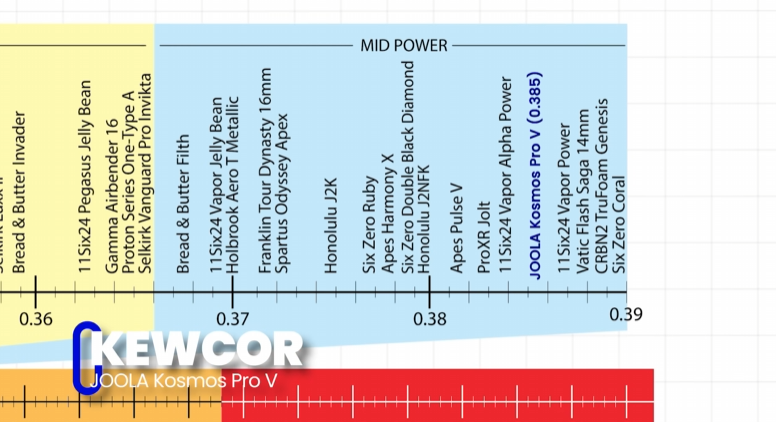
KewCOR comes in at 0.385, which places it in the upper end of the mid-power category. Pretty close to the original 11Six24 power series.
Now, what's interesting here is that my on-court impression actually felt like this paddle had slightly more firepower than the KewCOR suggests.
And I'm not the only one. We're seeing some mixed feedback across the Pro V line when it comes to perceived power. On court, I'd personally place this low in the power category, which lines up more with the radar data than KewCOR.
ON-COURT IMPRESSIONS
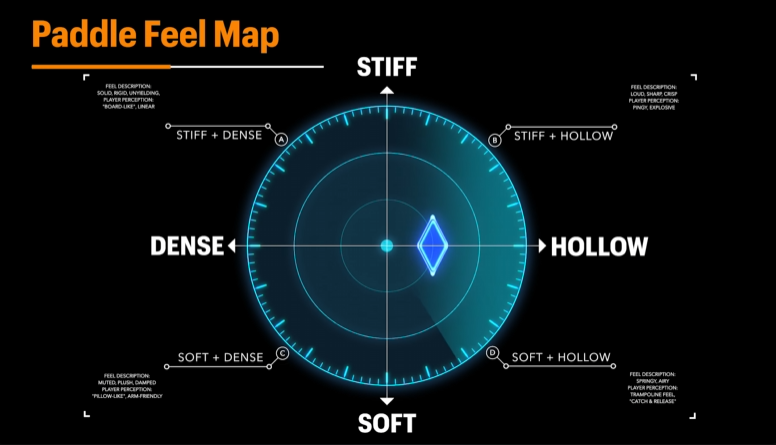
In terms of feel, this is definitely softer than the previous Pro IV version. The Pro IV had that stiff, hollow feel. The Pro V has a similar level of hollowness, but it's noticeably less stiff. It lands somewhere right near that stiff-to-soft boundary on the feel chart.
Honestly, most of the play characteristics of the paddle feel familiar if you're used to the Pro IV. The biggest difference I noticed is in pop.
This paddle is less poppy compared to the Pro IV. You still get strong top-end power on full swings, and serves, drives, and overheads are all there. But on resets and finesse shots, the ball just doesn't jump off the face as much. For me, that translated into a bit more control than the Pro IV. It's not a huge difference, but it's noticeable.
One thing I did notice is this paddle feels really good on drives. Something about that flex and release, that snapback, I could really feel it mostly on the really heavy, powerful swings like drives and serves. Personally, I didn't feel more accurate with this paddle, but I did feel more confident swinging big. And honestly, I probably hit a few too many drives when I should have been dropping instead.
Final Thoughts - Who it’s For
Like I said at the start, this paddle is an iteration, not a reinvention. JOOLA took a popular platform and made a subtle tweak that mostly affects feel and control. Compared to the Pro IV, you get a softer feel, slightly more control, and more predictable launch for advanced players.
14mm vs. 16mm
I played mostly with the 16mm, and that's what I'd recommend for most people. It felt more forgiving, more stable, and better aligned with what the new throat design is trying to do. The 14mm felt a little less stable and didn't have the same satisfying feel.
Who is this paddle for?
For most players, this is probably overpriced. You really need to be near the semi-pro level to get the most out of what this paddle is offering. And even then, the differences are subtle and not necessarily better than paddles that cost a fraction of the price.
That said, it's not a hard paddle to play well with at lower levels. It performs well. But there are plenty of other paddles that work just as well for amateur players, and in some cases even better depending on your style.
Bottom line: this paddle is best for advanced players who can generate their own power and are comfortable trading a bit of pop for more control and feel.
Who is it not for?
Budget-minded players. At $300, this is one of the most expensive paddles on the market. It's also not the right fit for players below the 5.0 level, who likely won't feel the difference this technology is meant to deliver. And honestly, even for advanced and pro players, the performance gap is very subtle.
One more thing worth flagging: if you've been burned by Gen 3 durability issues, be cautious. This is still a honeycomb-based build, so core crushing remains a real possibility.
Price: $300
Discount Code: None available
Warranty: 12 months
