
Paddle Database
This is an independent, lab-tested database of pickleball paddles.
Use the filters on the left to narrow by the specs that matter to you, then open any paddle for more details.
How every paddle is tested
Every value and metric in this database comes from the same controlled testing, not from spec sheets or manufacturer marketing. Here is what goes into each entry.
Firepower (KewCOR)
KewCOR is my ball-cannon measurement of a paddle's coefficient of restitution, which is how much energy it returns on contact. Each paddle is struck with an LT ball at a 50 MPH inbound speed and measured across the face, so the figure reflects real rebound rather than a label on a box. KewCOR sorts paddles into three performance profiles: Control (below 0.366), All-Court (0.366 to 0.39), and Power (above 0.39).
Power and pop
Power is ball speed off a full swing; pop is ball speed off a short, punchy swing like a punch volley. Both are scored as z-scores against the rest of the database and then combined into a single Firepower figure. That way a paddle that hits hard on big swings but is more muted with shorter strokes reads differently from one that hits hard across that spectrum.
Spin
Spin RPM is measured with a Stalker Pro 3s radar gun, recording ball revolutions per minute off a real swing. Above 2,300 RPM is Elite, 2,100 to 2,300 is Good, 1,900 to 2,100 is Fair, and below 1,900 is Poor. Spin measured off a human swing and spin measured by the ball cannon in a durability test are two different numbers from two different tools, so they are kept separate and never mixed.
Swing weight, twist weight, and balance
Swing weight is rotational inertia through a swinging motion, meaning how heavy the paddle feels to swing rather than what it reads on a scale. Twist weight is stability against off-center hits. Balance point is where the mass sits along the handle-to-face axis. These three shape how a paddle actually plays far more than static weight alone, which is why they are measured dynamically instead of estimated.
Build and durability
Many paddles are also analyzed by dissection in my lab to reveal core construction, and X-rays are available in this database (and the Radiology Lab) for viewing these constituent parts. Spin and texture durability are tested with the ball cannon and a high speed camera to see whether the spin they post on day one actually holds up. Peak spin when the paddle is new has never been the number that matters most. The number that matters is the one months down the road.
The physical specs, quickly
Alongside performance, each paddle lists its core thickness (thicker cores generally play softer and more controlled, thinner cores firmer and faster), length and width (shape and reach), handle length, and static weight (what it actually reads on a scale). Full definitions for every term are in the glossary.
Paddle Database FAQ
How are the paddles tested?
Every paddle is measured on the same equipment using the same protocol: KewCOR firepower on a ball cannon, power, pop, and spin RPM on a Stalker Pro 3s radar gun, and swing weight, twist weight, and balance measured dynamically. Many are also X-rayed and put through an accelerated spin-durability wear test. The goal is that any two or more paddles in the database can be compared directly, because they were tested the same way.
What is the best pickleball paddle for spin?
There is no single answer that stays true for long, because new paddles arrive constantly. The honest way to find the current best is to sort the database by Spin RPM, look at the Elite group at 2,300 RPM and above, and then filter by spin-durability result (Tier 1 spin durability results in 0 to 5% spin loss after accelerated wear). A paddle that spins high when new but loses its surface texture within a month is not really a spin paddle. Currently, four companies have engineered modern paddles with Tier 1 spin durability: Honolulu (all Blue Grit varieties), Six Zero (Coral Pro varieties), 11SIX24 (all HexGrit varieties), and Spartus (original PermaGrit varieties, noting that PermaGrit Nano is Tier 3).
How is spin measured, and what counts as a good RPM?
For accelerated wear testing, pre- and post-wear spin is measured with a high speed camera (Freefly Wave) in controlled laboratory conditions. The main RPM measurement for each paddle is recorded with a Stalker Pro 3s radar gun off a real swing. As a rough guide, above 2,300 RPM is Elite, 2,100 to 2,300 is Good, 1,900 to 2,100 is Fair, and below 1,900 is Poor. High spin on a brand-new paddle matters less than whether that spin survives, which is why the durability test exists.
What is swing weight, and is a higher number better?
Swing weight is how heavy a paddle feels to swing, measured as rotational inertia rather than read off a scale. Higher or lower is not automatically better. More swing weight usually means more power and more stability but slower hands, while less swing weight means quicker hands but a lighter hit. The right number depends on your style, which is why you can filter by it. In general, a high swing weight is 121 or more, mid is 113 to 120, and low is less than 113.
What is KewCOR?
KewCOR is my ball-cannon measurement of a paddle's coefficient of restitution, which is how much energy the paddle returns on contact. It is measured with an LT ball at a 50 MPH inbound speed and mapped across the face. It sorts paddles into Control, All-Court, and Power profiles, and it is the backbone of the Firepower rating.
How often is the database updated?
Continuously. New paddles are added as they are tested, and the database defaults to sorting by date entered, so the newest paddles sit at the top of the list.
How is this different from a brand's spec sheet or another paddle database?
Every paddle here is tested firsthand on the same equipment, so the numbers are directly comparable rather than pulled from different sources with different methods. There is no marketing speak here, as my lab is completely independent. Nothing is pay-to-play. A paddle is measured the same way and ranked the same way whether or not the brand sent it and whether or not there is an affiliate link on the page.
Do you earn money from the links?
Most paddle listings include affiliate links, and if you buy through one I earn a commission that helps support the website. It usually comes with a discount for you (you never pay more), and it never changes how a paddle is tested or where it lands in the data. The rankings come from the same lab protocol for every paddle.
How many paddles are in the database?
Hundreds, and the list keeps growing as new paddles are released and tested. That size is what makes the comparisons meaningful, since every metric is scored against the rest of the field rather than in isolation.
Can I compare two paddles side by side?
Yes. The Paddle Comparison Lab puts up to three paddles next to each other across their full performance profiles so you can see exactly where they differ instead of guessing from separate spec sheets.
Are the paddles certified for tournament play?
Certification is noted per paddle. USAP and UPA-A are the two certifying bodies you will see, and they use different testing standards, so a paddle can be approved under one and not the other. Check the individual paddle's page for its current certification before buying for sanctioned play.
Explore More Data

Paddle Database
Search, filter, and compare paddle metrics with our new database.
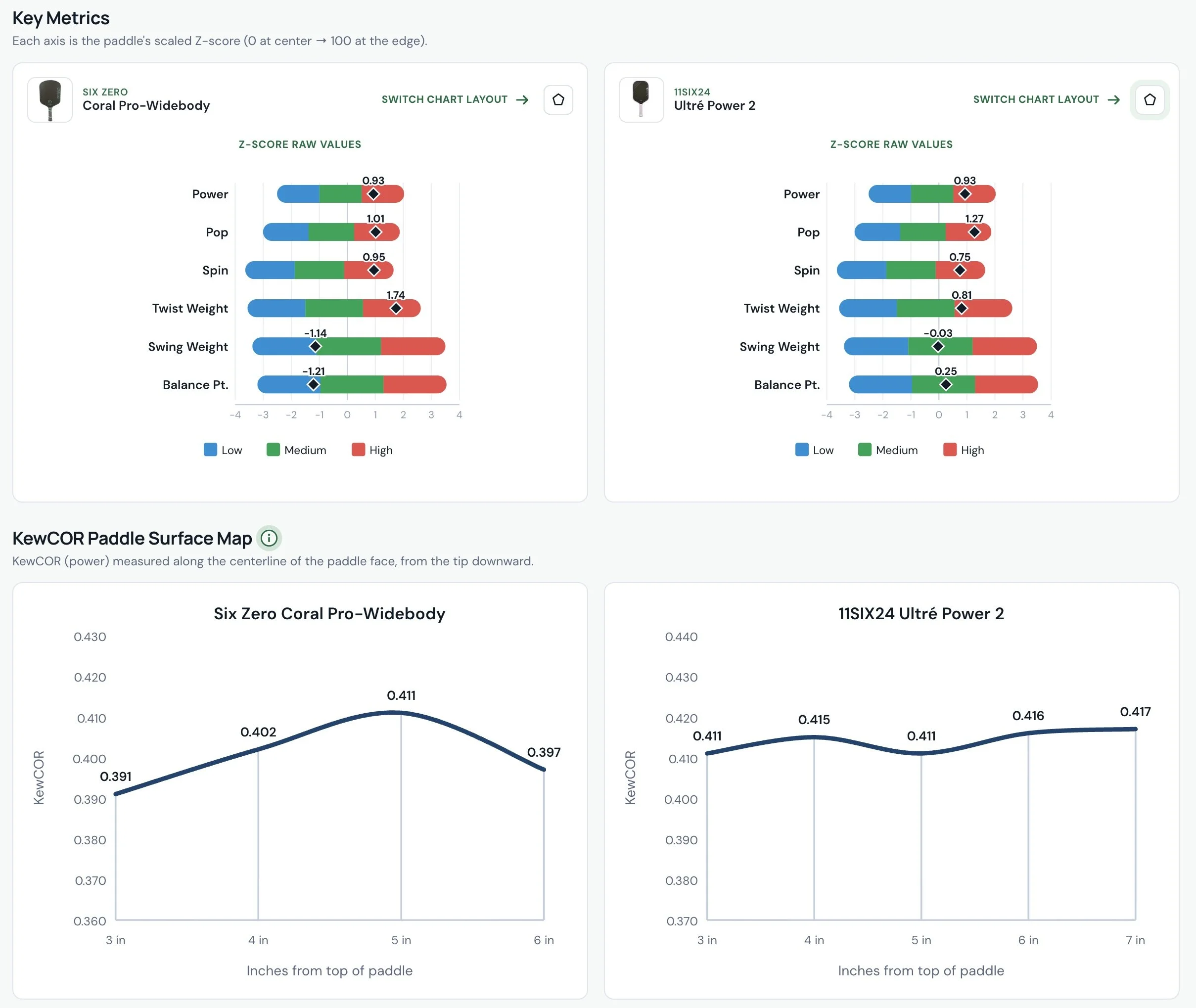
Paddle Comparison Lab
Newly constructed - allows deep insights into paddles in a side-by-side comparison, including z-score radar charts, bullet charts, KewCOR curves, feel mapping, and much more.

Ball Database
Metrics and statistics, like hardness and rebound, on most popular brands of pickleballs.