
Honolulu J6FC+ vs 11SIX24 Hurache-X Jelly Bean 2
Two 2026 elongated foam paddles at a similar price, split by spin on one side and forgiveness and certification on the other.
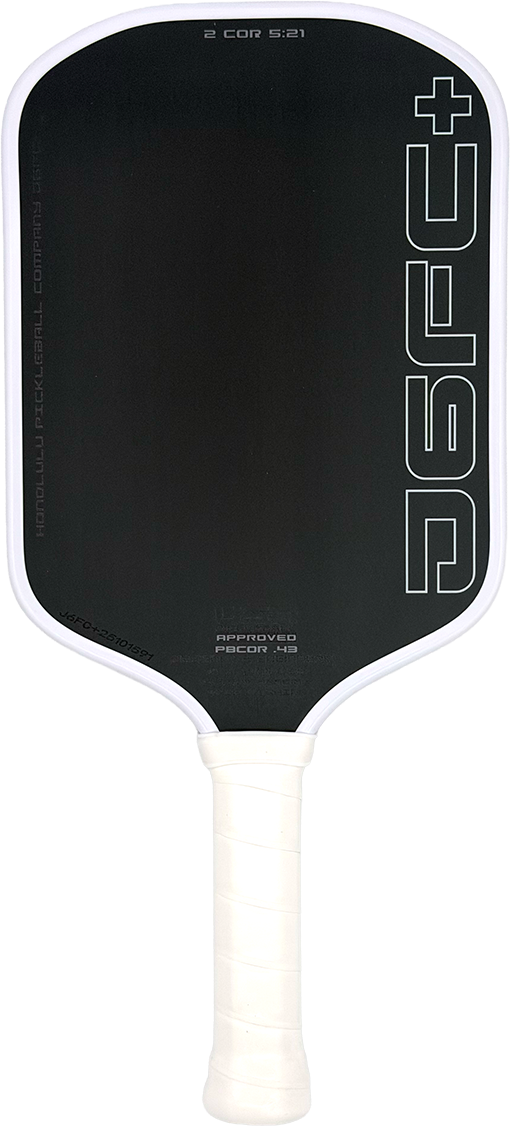
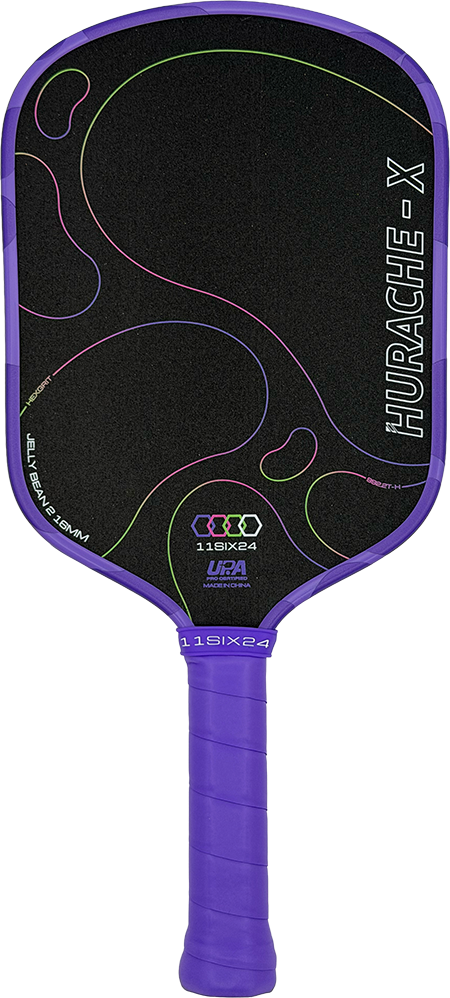
Quick take: These are both new-for-2026 elongated paddles built on 16mm Gen-4 full-foam cores, and they land close on price, so this is a clean comparison. The split is clear. The 11SIX24 Hurache-X Jelly Bean 2 is the spin paddle: Elite spin at 2,418 RPM and, more importantly, Tier 1 spin durability, the top of my retention scale, versus the J6FC+'s Good, Tier 4 spin. It is also quicker in the hand, has a longer handle, and costs a bit less. The Honolulu J6FC+ answers with forgiveness and eligibility: a much higher twist weight for stability on off-center hits, a little more plow-through, and USAP certification, where the Jelly Bean 2 is UPA-A only. Power is close to even. So this comes down to spin, durability, and price against forgiveness and tournament certification.
Certification matters here: the Honolulu J6FC+ is USAP certified, while the 11SIX24 Hurache-X Jelly Bean 2 is UPA-A certified only. If you compete in USA Pickleball (USAP) sanctioned events, the Jelly Bean 2's UPA-A-only approval may not be allowed on court, while the J6FC+ is. If you play recreationally or in UPA-A and PPA events, both are fine.
Full spec comparison
| Metric | Honolulu J6FC+ | 11SIX24 Hurache-X Jelly Bean 2 |
|---|---|---|
| Price | $175.50 with code JOHNKEW | $159.99 with code JOHNKEW cheaper |
| Shape | Elongated | Elongated |
| Spin RPM | 2,256 (Good) | 2,418 (Elite) more spin |
| Spin durability | Tier 4 | Tier 1 holds spin |
| KewCOR (firepower) | 0.390 (All-Court) | 0.390 (All-Court) |
| Firepower (0-100) | 66 hotter | 56 |
| Serve speed (power) | 60.4 mph | 59.7 mph |
| Punch volley (pop) | 38.2 mph | 37.7 mph |
| Swing weight | 119.7 more plow | 117.8 |
| Twist weight | 6.82 more forgiving | 6.09 |
| Balance point | 24.0 cm | 24.4 cm |
| Static weight | 8.1 oz | 8.1 oz |
| Length x width | 16.48 x 7.52 in | 16.42 x 7.48 in |
| Handle length | 5.67 in | 5.91 in longer handle |
| Build | Gen-4, thermoformed | Gen-4, thermoformed |
| Core | Full foam (EPP with EVA border) | Full foam (EMA, EVA and expanding foam) |
| Surface | Peel ply coarse, T700 carbon | Grit-infused peel ply, Toray carbon |
| Certification | USAP USAP certified | UPA-A only |
| Warranty | 1 year | 1 year |
Spin: the clearest gap
This is where the two separate most. The Hurache-X Jelly Bean 2 reads 2,418 RPM and sits in my Elite tier, and just as important, it holds that spin at Tier 1 for durability, the top of my spin-retention scale. The J6FC+ reads 2,256 RPM, which lands in the Good tier, and it holds spin at Tier 4, meaning its grit wears in faster and the spin fades sooner. The surfaces line up with that result: the Jelly Bean 2 uses a grit-infused peel ply, while the J6FC+ uses a coarse peel ply. If spin, and spin that lasts, is your priority, the Jelly Bean 2 wins this clearly.
Power: essentially a tie
On sweet-spot power the two are dead even: both post a KewCOR of 0.390, which lands in my All-Court band. The J6FC+ takes a small edge on the composite picture, with a Firepower score of 66 to the Jelly Bean 2's 56 and slightly higher raw numbers on serve (60.4 vs 59.7 mph) and pop (38.2 vs 37.7 mph). Those are modest gaps, so I would not choose between these two on power. Call it a marginal nod to the J6FC+ with identical KewCOR.
Forgiveness, weight, and feel
This is the J6FC+'s side of the ledger. It carries a much higher twist weight, 6.82 versus 6.09, so it is noticeably more stable on off-center hits, and a slightly higher swing weight (119.7 vs 117.8) for a bit more plow-through. The Jelly Bean 2 trades some of that stability for hand speed: it is the quicker paddle to swing and it has the longer handle at 5.91 inches versus 5.67, which matters if you hit a two-handed backhand. On my Feel Map both land in the Soft plus Dense quadrant, but the J6FC+ sits almost dead center, reading as very neutral, while the Jelly Bean 2 is further into the soft, dense corner, so it plays a touch softer and more muted by comparison.
Build and certification
Structurally these are close siblings: both are elongated, 16mm, Gen-4 thermoformed paddles on full-foam cores, the J6FC+ on an EPP foam core with an EVA border and the Jelly Bean 2 on a foam blend of EMA, EVA, and expanding foam. There is no meaningful construction gap. The difference that will actually decide some purchases is certification. The J6FC+ is USAP certified, so it is legal for USA Pickleball sanctioned play. The Jelly Bean 2 is UPA-A certified only. For a lot of sanctioned USAP events, that makes the J6FC+ the eligible paddle of the two, regardless of the spin numbers.
Feel Map
Both paddles fall in the Soft plus Dense quadrant, but they sit at different distances from center. The J6FC+ is almost exactly at the middle of the map, which reads as a very neutral, balanced feel. The Hurache-X Jelly Bean 2 sits further into the soft, dense corner, so it comes across as a little softer and more muted at contact.
Who each one is for
Get the 11SIX24 Hurache-X Jelly Bean 2 if spin is the point: it is Elite for spin and Tier 1 for spin durability, so it holds its bite far longer than the J6FC+. It is also the quicker paddle in the hand, has the longer handle, and costs a bit less. For a lot of players choosing on performance and value, this is the pick, as long as UPA-A certification covers where you play.
Get the Honolulu J6FC+ if you want the more forgiving and more stable paddle, or you need USAP certification for sanctioned play. Its higher twist weight makes it steadier on off-center hits, it has a touch more plow-through, and it is USAP legal. You give up spin and, more notably, spin durability to get there, and you pay a little more.
Who neither is for: players chasing a stiff, poppy power paddle. Both of these are neutral to soft, All-Court-power paddles, so if raw firepower and a crisp feel are your priority, look elsewhere in the database.
Frequently asked questions
Which has more spin, the Honolulu J6FC+ or the Hurache-X Jelly Bean 2?
The Hurache-X Jelly Bean 2, clearly. It reads 2,418 RPM in my Elite tier and holds that spin at Tier 1 for durability. The J6FC+ reads 2,256 RPM in the Good tier and holds spin at Tier 4, so its spin fades faster with use.
Which is more powerful?
They are essentially even. Both post a KewCOR of 0.390 in my All-Court band. The J6FC+ takes a small edge on the composite Firepower score (66 to 56) and on raw serve and pop, but the gaps are modest, so power should not be the deciding factor.
Which is more forgiving?
The J6FC+. It has a much higher twist weight (6.82 vs 6.09) for more stability on off-center hits and a slightly higher swing weight (119.7 vs 117.8) for more plow-through. The Jelly Bean 2 is quicker in the hand but less stable on mishits.
Are both paddles USAP approved?
No. The Honolulu J6FC+ is USAP certified. The 11SIX24 Hurache-X Jelly Bean 2 is UPA-A certified only. If you play in USA Pickleball sanctioned events, the J6FC+ is the eligible option of the two.
Which has the longer handle?
The Hurache-X Jelly Bean 2, at 5.91 inches versus 5.67 inches for the J6FC+. If you hit a two-handed backhand, the Jelly Bean 2 gives you more room.
Which is cheaper?
The Hurache-X Jelly Bean 2, at $159.99 with code JOHNKEW versus $175.50 for the J6FC+ with the same code. Both are premium foam-core paddles, so the price gap is modest.
← Browse all paddle matchupsSee these paddles in the full database →
Quick disclosure: I test every paddle independently, with no payment and no editorial input. The buy links are affiliate links and use my code JOHNKEW; if you use them I earn a commission that helps support the website. It never changes how a paddle is tested or where it lands in the data.