

JOOLA Power FX Review — First Hits
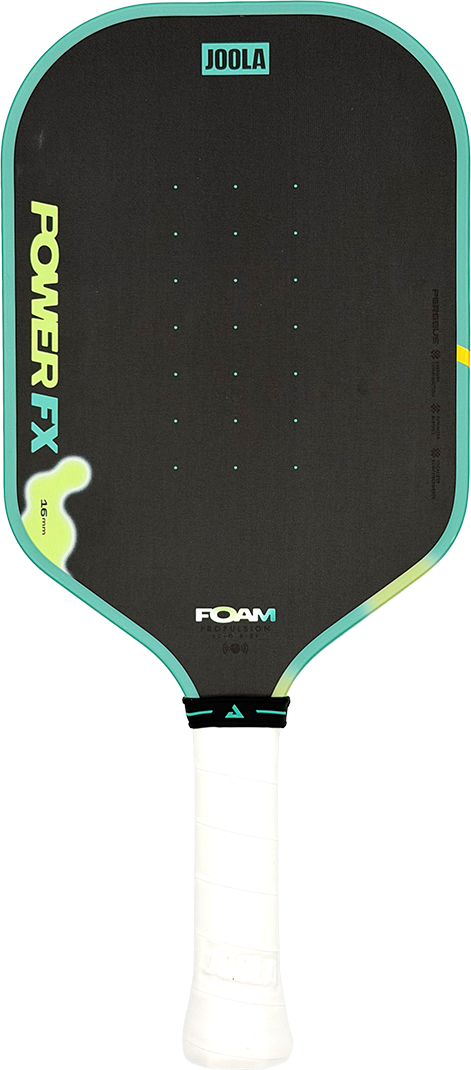
The Power FX is JOOLA's first real swing at a full-foam paddle, and it launches September 30 at $179.95, which is a lower price point for JOOLA. For a brand that spent years making the case for honeycomb core construction over foam, that's a real shift in direction, not just a new SKU.
It's available in one shape (Perseus) and one thickness (16mm) at launch.
Spin RPM comes in at 2,147, a scaled score of 70 out of 100. And spin durability tests at Tier 3, a 15% drop in spin from new to post-wear, which is an improvement over JOOLA's previous paddles, which used raw carbon fiber and tested at Tier 4 (20% or more spin loss after accelerated wear).
KewCOR lands at 0.417, a Firepower score of 60.5 out of 100, inside Power (Mid) territory.
The Power FX uses a center column of EPP (expanded polypropylene) foam that runs from the handle up into the face, surrounded by an EVA foam perimeter ring. That EVA ring runs almost all the way up to the throat before tapering off without actually connecting there, so this reads as an almost-fully-floating full-foam build rather than a fully floating one. There's also a split in the EVA band near the top of the paddle. I'm not sure if they are using two densities of EVA, or what the purpose of that split is. I'm going off JOOLA's own render for the internal geometry description, not my own x-ray or CT scan, so treat the exact layout as provisional until I can image one myself.
The surface is new for JOOLA too: a coarser peel-ply texture than what they've used on past paddles, paired with a T700 carbon fiber face. See Spin Durability below for how it actually performed in testing, rather than how it looks.
| Shape / Build | Perseus, Elongated, Gen 4 |
| Surface | Peel Ply, Coarse |
| Layup | T700 Carbon Fiber |
| Core | Full Foam (EPP + EVA Ring, almost fully floating) |
| Thickness | 16mm |
| Length × Width | 16.5″ × 7.44″ |
| Handle Length | 5.51″ |
| Static Weight | 7.9 oz |
| Swing Weight | 114.5 |
| Twist Weight | 6.12 |
| Balance Point | 23.9 cm |
| Certification | Dual Certified (USAP + UPA-A) |
| Warranty | 1 year |
| Retail Price | $179.95 |
KewCOR is a controlled firepower metric: how efficiently the paddle transfers energy back into the ball, measured with a ball cannon.
KewCOR comes in at 0.417, a Firepower score of 60.5 out of 100, landing in Power (Mid), comfortably inside the Power band but well short of Very High Power. Power and pop scale at 65 and 63 respectively, a fairly balanced firepower profile rather than one leaning hard toward either full swings or short-swing pop. That being said, it feels very poppy, because of how stiff it is. More on that below in the Feel section.
Spin RPM (human-generated) measures 2,147, a scaled score of 70, which falls into the 'Good' category. Frankly, I was surprised it didn't land higher, given the aggressive texture. I did notice some variability in RPM shot-to-shot, and I suspect the surface is a coated peel-ply, which can sometimes reduce the friction of the surface, regardless of how rough it feels. If that's the case, the ball was slipping slightly on some of my topspin serves, leading to lower RPM.
Spin durability as measured with a controlled cannon test comes in at Tier 3, a 15% drop in spin from new to post-wear, a real, middle-of-the-pack result rather than a durability standout. That's worth knowing going in, since a lot of the paddles this one is about to compete against in the $180 to $200 range already carry Tier 1 durable grit surfaces.
This is the part of the paddle with the most personality, for better or worse. On the Feel Map, the Power FX plots deep in the stiff-hollow quadrant, and its stiffness (y-axis) value is the single highest of any paddle currently in my database, out of 236 plotted paddles, verified by sorting the full dataset rather than eyeballing it. It's very stiff, and it makes a loud, high-pitched, hollow “ping” when you hit the ball. Most full-foam paddles on the market right now have gone the opposite direction: softer and bassier as the category has matured, closer to something like the Six Zero Coral Pro-Widebody plotted for reference below. This one sings like a soprano next to them. I haven't hit a Gen-4 full-foam paddle that sounds or feels quite like this one.
The 4 paddles in the database with the closest overall performance profile, scored across spin, dimensions, weight/balance, power, pop, KewCOR, and feel profile.
I've only played a few games with the JOOLA Power FX so far, so treat this section specifically as preliminary. A few games in, my honest read is that this is going to be a polarizing paddle. The feel profile alone is going to turn some players off the moment they hear that first “ping,” and other players are going to love exactly that same thing. I don't think there's a consensus verdict to give yet, and I'm not going to pretend there is one after a handful of games. I'll update this section as I log more court time.
Given its stiffness, this paddle feels very poppy. Like the ball wants to be off the paddle immediately. That can lead to the feeling that this paddle is harder to control, although if you're already dialed into a stiffer paddle (e.g., Boomstik, Q2), you won't have an issue controlling the Power FX.
The sweet spot is about average for a Gen-4 paddle, in my opinion, but there are a lot of vibrations that will tell you when you're hitting off-center. This will be perceived by some people as a smaller sweet spot based on those vibrations, which are unrelated to the velocity of the ball coming off the paddle. In other words, I don't feel any hot spots or dead spots on this paddle, but it definitely tells me when I hit off center.
JOOLA is entering a genuinely crowded part of the market with this one. The $180 to $200 full-foam range is where a lot of the category's growth is happening right now, and Honolulu, 11SIX24, Six Zero, Selkirk, Bread & Butter, and several others are already established there. Many of those paddles already carry Tier 1 durable grit, which puts the Power FX's Tier 3 result at a real disadvantage on paper against the competition it's actually going to be shopped against, not just against JOOLA's own older honeycomb paddles.
Who it's for
- Players curious about a genuinely different feel profile in the full-foam category: the stiffest, brightest-sounding paddle in my entire database, instead of the softer, bassier direction most recent Gen-4 paddles have moved toward.
- JOOLA loyalists who want to follow the brand into full-foam construction at the lowest price point they've ever launched at.
- Players shopping at the low end of the full-foam price range: $179.95 undercuts most of its direct competition.
Who it's NOT for
- Players prioritizing spin durability above other factors. Tier 3 (15% loss) is a step behind several Tier 1 competitors in this same price range.
- Players who've come to prefer the softer, bassier feel most recent Gen-4 full-foam paddles have moved toward. This one is the opposite of that trend, and by a wide margin.
- Anyone who struggles with controlling a stiffer power paddle. Expect pop-ups if you're coming from a soft control paddle, at least until you've spent good time with this one to get it dialed-in.
The JOOLA Power FX already has a clear identity: a stiff, loud, distinctly different full-foam paddle at JOOLA's lowest launch price yet, arriving in a category that's getting more crowded by the month. Tier 3 spin durability keeps it from competing shot-for-shot against the Tier 1 grit surfaces already established in its price range, but the feel profile is different enough, genuinely the stiffest paddle I've measured, that I don't think spin durability alone is going to decide this one for most players. I'll have a fuller court-time verdict once I've logged more games.