

Neonic NeoGrit FLX Review (Frost and Swift)
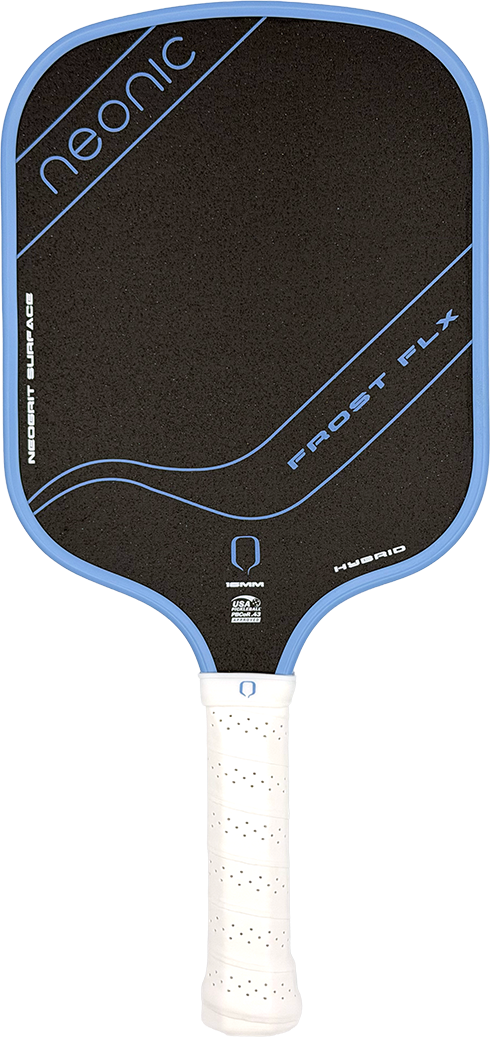
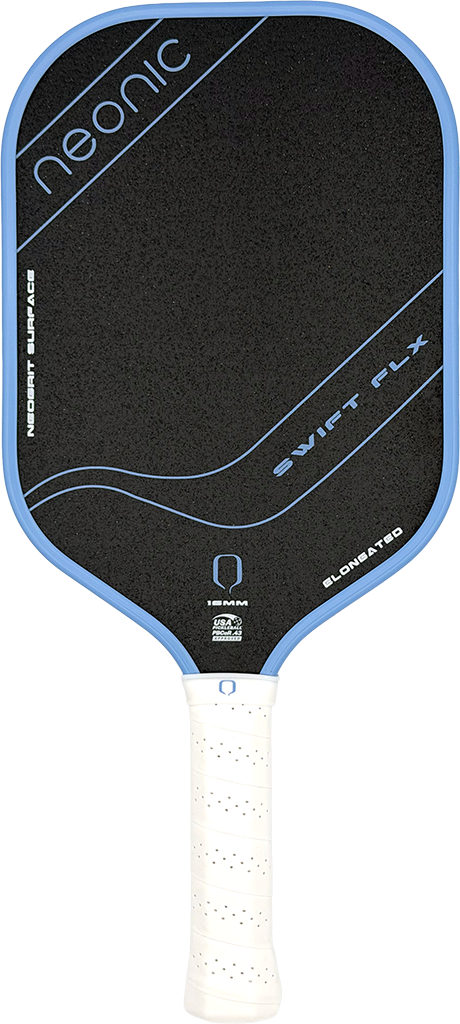
Neonic's NeoGrit FLX comes in two shapes, the Frost (hybrid) and the Swift (elongated). Both are 16mm full-foam Gen-4 paddles with a grit-infused peel-ply surface, listed at $110, or $99 with my code JOHNKEWon launch pricing of $100, or $90 with my code JOHNKEW, through Nov 30 (normally $110). Both have a forgiving sweet spot and a pleasant, soft feel, and that soft feel hides how much firepower they have. KewCOR is 0.424 on the Frost and 0.422 on the Swift, both in the middle of the Power category.
The Frost is a little stiffer, whippier and poppier. The Swift felt softer, more forgiving and more controllable to me, and it is my favorite of the two. Spin is Elite on both shapes: 2,454 RPM on the Frost and 2,404 RPM on the Swift.
In my cannon test, a Frost held its spin through 100 impacts of accelerated wear (+6.8%, Holds, high confidence), and that result is listed for both shapes. That is controlled cannon testing, not a prediction of how long the paddle lasts on the court. Real-world durability is still to be determined.
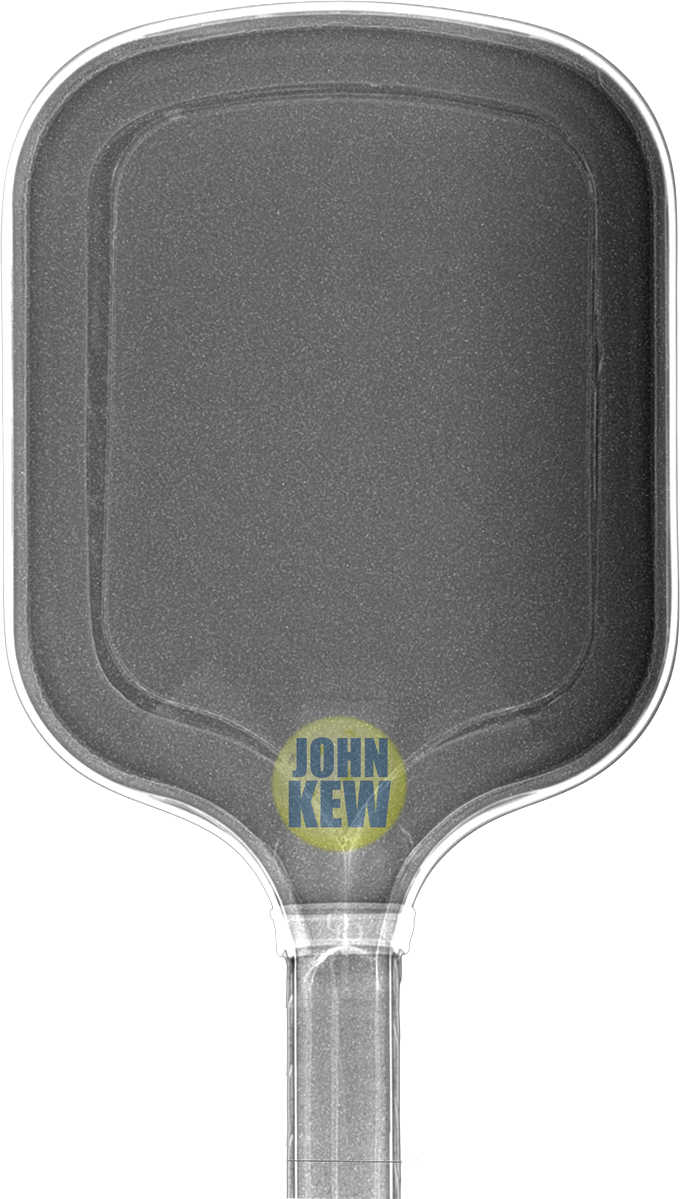
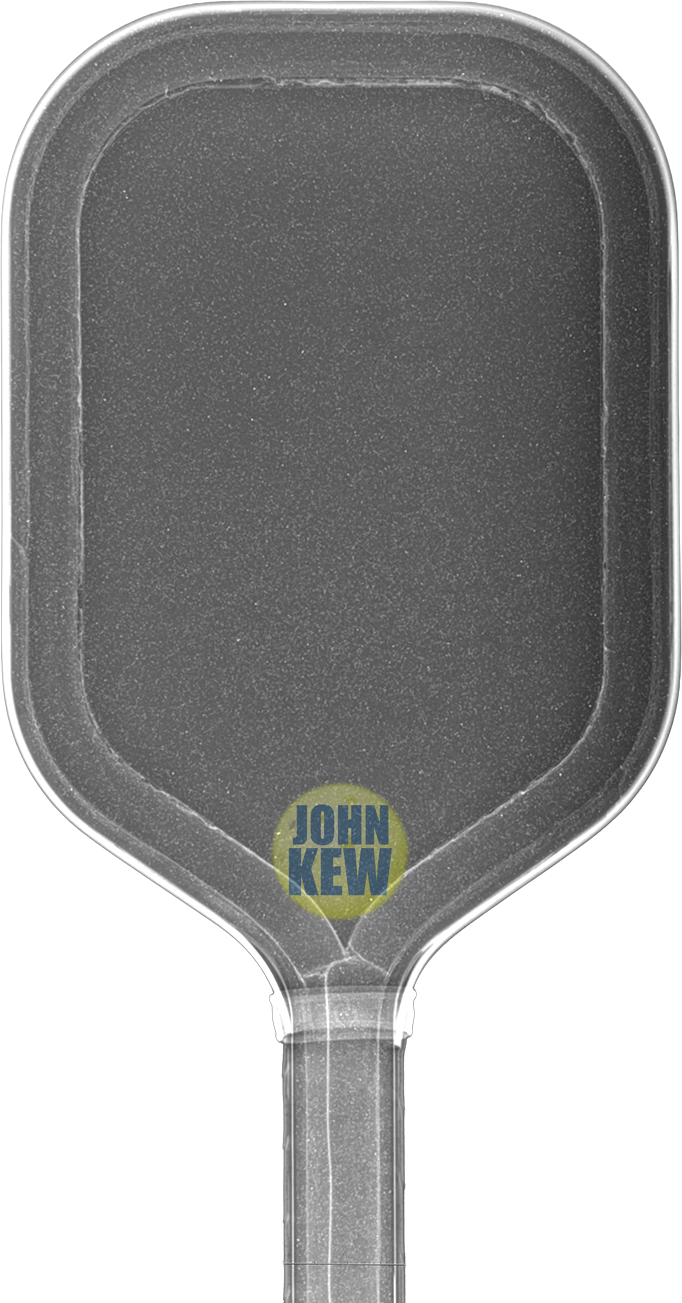
Both shapes are built the same way: a thermoformed Gen-4 build with a full-foam core (MPP plus EVA) under a T700 carbon fiber face, finished with Neonic's NeoGrit surface. My database lists that surface as a coarse, grit-infused peel ply. The X-rays above show the foam inside each shape.
| Frost FLX (Hybrid) | Swift FLX (Elongated) | |
|---|---|---|
| Length x Width (in) | 16.2 x 7.8 | 16.5 x 7.5 |
| Core thickness (mm) | 16 | 16 |
| Static weight (oz) | 7.6 | 7.6 |
| Swing weight | 107.7 | 110.2 |
| Twist weight | 6.52 | 6.06 |
| Balance point (cm) | 23.7 | 24.1 |
| Handle length (in) | 5.5 | 5.5 |
| Face deflection (lbs) | 48.1 | 43.0 |
| Hand Speed Index (0 to 100) | 87 | 77 |
| Certification | USAP | USAP |
| Warranty | 1 year | 1 year |
| Price | $110 ($99 with JOHNKEW)$100 launch price ($90 with JOHNKEW) | $110 ($99 with JOHNKEW)$100 launch price ($90 with JOHNKEW) |
Both paddles weigh 7.6 oz and swing at roughly 108 to 110, so neither is heavy. The Frost is the more maneuverable of the two: its swing weight is lower and its Hand Speed Index is 87, versus 77 for the Swift. That matches what I felt, a whippier paddle. The Swift gives you the extra reach of the elongated shape, 16.5 inches long versus 16.2.
The Frost is also the stiffer face. It took 48.1 pounds of force to push the face in a sixteenth of an inch, versus 43.0 pounds on the Swift. Twist weight, a read on how stable the paddle is on off-center hits, is higher on the Frost, 6.52 versus 6.06. On paper that makes the Frost the more stable paddle, which is not how it played for me. More on that in the on-court section.
Both are USAP certified and carry a one-year warranty. The price is $110 for either shape, or $99 with my code JOHNKEW.The price is $110 for either shape, but through Nov 30 there is a launch deal: $100, or $90 with my code JOHNKEW.
KewCOR is a controlled firepower metric: how efficiently the paddle transfers energy back into the ball, measured with a ball cannon. Firepower is a 0 to 100 score built from KewCOR, and the bar shows exactly where each paddle sits on the KewCOR scale.
KewCOR comes in at 0.424 on the Frost and 0.422 on the Swift, both in the middle of the Power category. Firepower scores are 63 and 62 out of 100. The two are effectively tied on serve speed (Power), both about 61.3 mph. The Frost has a small edge on punch-volley speed (Pop), 39.4 mph versus 39.3, or 70 versus 67 on my scaled scores. That agrees with what I felt: the Frost is the poppier of the two, though the gap is small.
The soft feel hides the firepower. These do not feel like Power-category paddles in the hand, and the numbers say they are.
Spin on serves averaged 2,454 RPM on the Frost and 2,404 RPM on the Swift. Both shapes land in the Elite category, with scaled scores of 98 and 93 out of 100.
A quick reminder: this is the spin a human generates in a swing, measured by radar. The cannon numbers in the Spin Durability section below are a different measurement entirely, so don't compare the two.
Full Feel Map scale. Both paddles land in Quadrant D (soft and hollow), close to the center. The square is the Frost and the circle is the Swift.
I plot every paddle on a Feel Map: stiff to soft, and hollow to dense. Both NeoGrit FLX shapes land in Quadrant D, soft and hollow, and both sit fairly close to the center of the map, so neither is an extreme. They are almost identical on the dense to hollow axis. The Swift is the softer of the two, about 0.6 points lower on the stiff to soft axis, which fits with the Frost's stiffer face in the deflection numbers.
Before any numbers, a clear caveat. This is controlled cannon testing. My accelerated wear test is not an exact replica of real-world use, and it is not a clock that converts to games or months of play. It is a comparative analysis between surfaces under identical conditions, not a direct prediction of real-world lifespan. How the NeoGrit surface holds up on the court is still to be determined.
Here is what I did. I took a production Frost FLX hybrid and measured its spin off my ball cannon: LT Pro 48 balls at 60 MPH with the paddle clamped at 30 degrees, read with a high-speed camera at 2,032 frames per second, 10 shots. Then the paddle took 100 impacts at 70 MPH to wear the surface down, and I repeated the same 10-shot measurement. The result is the percent change in spin from new to after 100 impacts, with a 95% confidence interval. The published result lists both shapes, and the shape I actually tested was the Frost.
- ✓ Holdsthe 95% interval reaches no loss, and its loss end does not pass 12%
- ▾ Moderate lossbetween Holds and 20% loss
- ▾▾ Heavy lossloss of 20% or more
- ▴ Measurable gainthe 95% interval sits entirely above zero
Confidence shows how far the 95% interval stretches across the 0% and 20% reference lines: high means it stays within one zone. For Holds, gain and 0% to 20% loss count as one zone. See every paddle on the Cannon-Tested Spin Durability page.
The Frost averaged 2,048 RPM new and 2,187 RPM after wear. So it did not lose spin. It went up about 6.8%. The 95% interval on that change runs from a 0.5% loss to a 14.1% gain. It touches zero (a p-value of about 0.07), so I can't call it a Measurable gain. Read it as flat to higher. That is what Holds means here: the measurement cannot tell this paddle apart from no loss, and the loss end of the interval stays well under the 12% line.
I also measured the surface itself with a Starrett roughness gauge, before and after wear. Surface texture dropped, but spin did not.
| Frost FLX (Hybrid) | New | After 100 impacts | Change |
|---|---|---|---|
| Cannon spin (RPM) | 2,048 | 2,187 | +6.8% |
| Rz roughness (µm) | 37.6 | 32.6 | -13.3% |
| Rt roughness (µm) | 76.9 | 65.1 | -15.4% |
The steeper drop in surface texture is a bit of a surprise, especially considering the RPM increased (didn't drop). If you look at the post-wear roughness, though, it is still very aggressive. Anything over 30 Rz and 50 Rt is a very aggressive texture. So it's just something to keep an eye on, and we'll be logging real-world games and hours to see how texture and spin hold up outside of the lab.
Here is where I land. Based on the cannon, the NeoGrit surface held its spin through accelerated wear, which is a strong early result for a paddle at this price. It is still a lab result from a single unit, and it needs real court time before I would call it proven. Cannon spin is also not comparable to the spin a human swing produces, so don't read the RPM numbers above as how much spin you will make.
The headline is that these are two similar paddles with a forgiving sweet spot and a soft feel that hides how much firepower they have.
Both shapes have a forgiving sweet spot, and to me the Swift felt the more forgiving of the two. Twist weight actually favors the Frost on paper, so this is one of those cases where the numbers and the feel in my hand do not line up neatly.
The Frost is a little stiffer and whippier, which fits its higher face deflection and its higher Hand Speed Index. It is also the poppier of the two, so if you want a bit more kick off the face, that is the shape to look at.
Both paddles have a pleasant, soft feel, and that is the part that hides the true firepower. Nothing about the way they feel in the hand tells you they are Power-category paddles. Then you take a big swing and the ball comes off with ample firepower. It is not only a big-swing story either. On shorter strokes, like speedups and counters, both shapes still have plenty of power to work with.
My favorite shape is the Swift. It feels more controllable and softer to me.
The paddles in the database with the closest overall performance profile to each shape, scored across spin, dimensions, weight/balance, power, pop, KewCOR, and feel profile. Neonic's other Frost FLX and Swift FLX listings are left out so you see other paddles.
The first thing to know is the price. At $110, or $99 with my code, the NeoGrit FLX is priced like a budget paddle but measures like a premium one. Right now it is cheaper still: the Frost and Swift are $100 on Neonic's site through Nov 30 (it is a launch preorder), and my code JOHNKEW stacks for 10% off that, which brings either shape to $90. Of the 89 Elite-spin paddles in my database with a listed price, only 8 list at $110 or less, and these two are among them. The median Elite-spin paddle lists at about $200.
The closest matches show how unusual that is. The Frost's closest match is the Vatic Pro V-Sol Tour Flash, a hybrid that lists at $109.99, essentially the same price. The Swift's closest match is the Volair CMD EL at $179.99.
Who it's for
- Players who want Elite spin and Power-category firepower in a soft-feeling, forgiving paddle.
- Players who want the most controllable, softest option: the Swift.
- Players who want a slightly stiffer, whippier and poppier paddle: the Frost.
- Anyone shopping the $100 range who does not want to give up spin.
Who it's NOT for
- Players who want a firm, crisp feel. Both shapes sit on the soft side of my Feel Map, and that softness is what hides the firepower.
- Players who want a heavy, plow-through paddle. Both are 7.6 oz with swing weights around 108 to 110.
- Players who need proven long-term durability. The cannon result is encouraging, but it is a lab result from a single unit and real-world durability is still to be determined.
Neonic has built two very similar paddles with a forgiving sweet spot, a soft feel that hides real firepower, and Elite spin, at $110a $100 launch price ($90 with my code). The Frost is the stiffer, whippier, poppier shape. The Swift is the softer, more forgiving, more controllable one.
The caveat is the usual one. The spin durability result is a strong early signal from controlled cannon testing on a single unit, and real-world durability is still to be determined. It tells me the surface held its spin under identical lab conditions, not how many games it will last.
My personal choice is the Swift. It feels more controllable and softer to me. If you know you want more pop and a quicker paddle in the hand, go with the Frost.