

Top 3 Budget Paddles of 2026 (Q4)
Updated November 22, 2026. This is a round-up of my current budget picks, not a final ranking: a winner will be chosen in December for my 2026 paddle awards. Sale prices on this page switch back to regular pricing automatically when each sale ends.
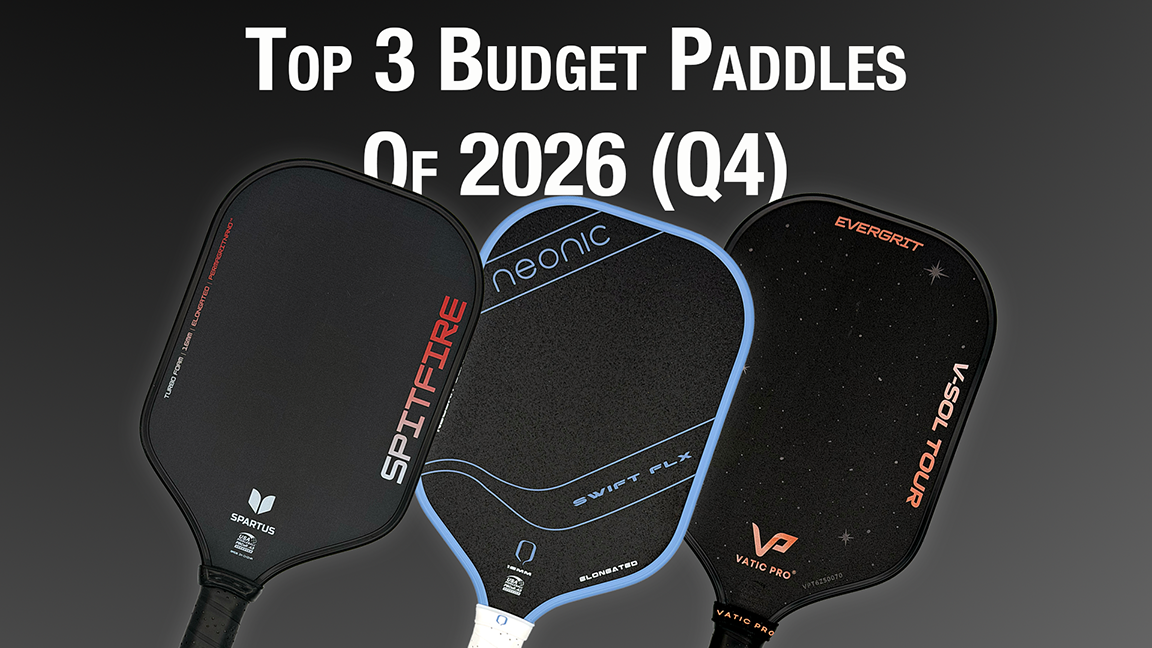
My three budget picks for Q4 2026 are the Spartus Spitfire, the new Vatic V-Sol Tour (with the revised EverGrit surface), and the Neonic NeoGrit FLX. All three list at about $110 (about $100 after my code), all three are 16mm full-foam Gen-4 paddles with Elite spin, and all three have a durable grit. To keep the comparison simple I'm using the elongated shape of each: the Spitfire Elongated, the V-Sol Tour Elongated and the NeoGrit Swift FLX. I'm also highlighting the new V-Sol Tour Flash FT, which is my favorite shape in the Vatic lineup.
The big story is where they sit on my Feel Map. All three are in the soft-hollow quadrant, and that is a major shift. Until very recently, nearly all of the most popular power paddles were stiff-hollow. The extra softness allows more pocketing and gives an added perception of control. Below I use my paddle database to show how fast that shift is happening.
I am not choosing a winner out of these three yet. I need more time with the FLX and the Tour. A winner will be chosen in December for my 2026 paddle awards.
Specs & Shapes
Elongated shape of each model, plus the Vatic V-Sol Tour Flash FT. The Neonic elongated is the Swift FLX.
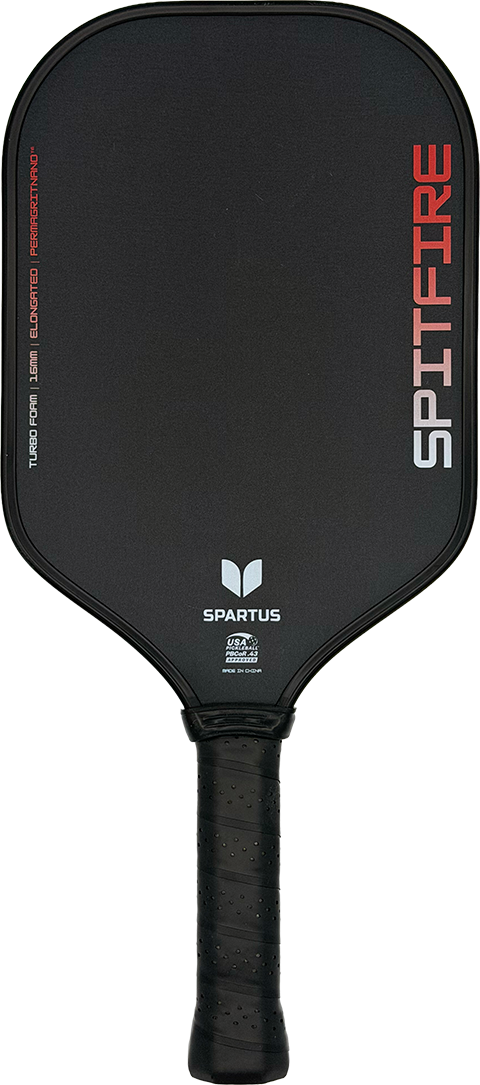 Spitfire Elongated | 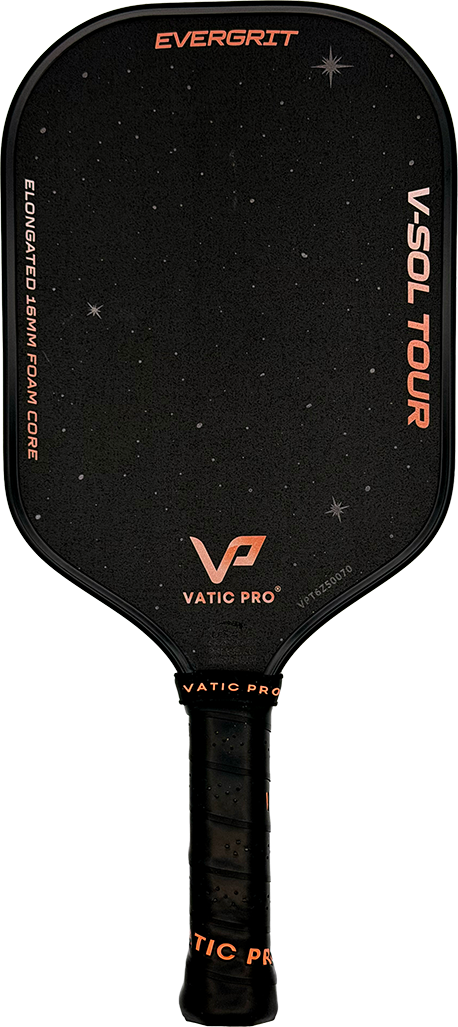 V-Sol Tour Elongated | 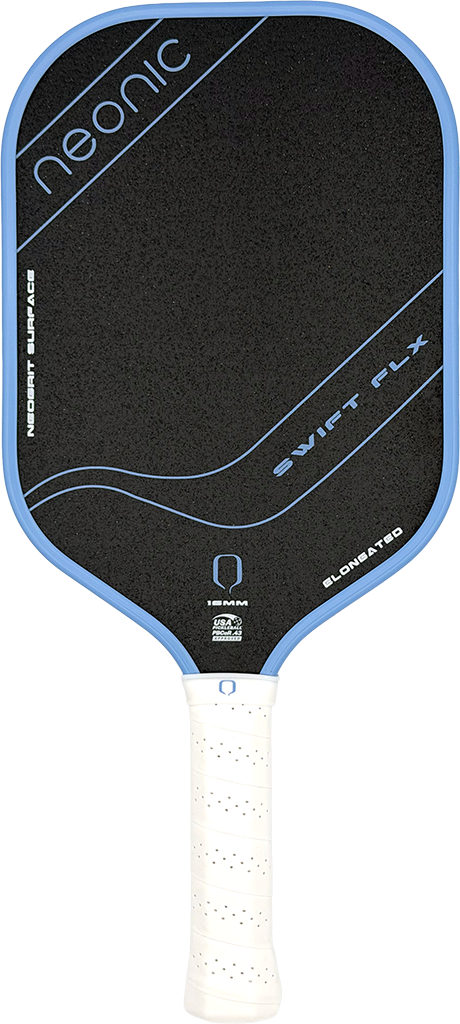 NeoGrit Swift FLX | 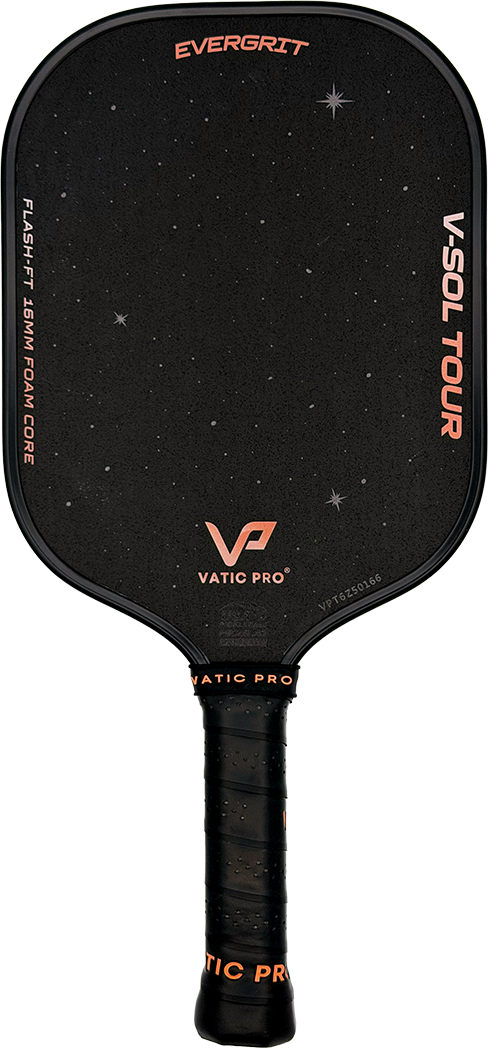 V-Sol Tour Flash FT | |
|---|---|---|---|---|
| Shape | Elongated | Elongated | Elongated | Hybrid |
| Length x Width (in) | 16.46 x 7.4 | 16.5 x 7.5 | 16.5 x 7.5 | 16.26 x 7.72 |
| Core thickness (mm) | 16 | 16 | 16 | 16 |
| Core | Full-foam (EPP, EVA border) | Full-foam (EPP, EVA ring) | Full-foam (MPP, EVA) | Full-foam (EPP, EVA ring) |
| Face | T700 carbon | CFC (carbon, fiberglass, carbon) | T700 carbon | CFC (carbon, fiberglass, carbon) |
| Surface | Grit-infused peel ply | Grit-infused peel ply, coarse | Grit-infused peel ply, coarse | Grit-infused peel ply, coarse |
| Static weight (oz) | 7.8 | 7.9 | 7.6 | 8.0 |
| Swing weight | 116.2 | 115.2 | 110.2 | 112.2 |
| Twist weight | 6.14 | 5.96 | 6.06 | 6.35 |
| Balance point (cm) | 24.8 | 24.0 | 24.1 | 23.7 |
| Handle length (in) | 5.51 | 5.5 | 5.5 | 5.75 |
| Face deflection (lbs) | 34.0 | 42.0 | 43.0 | 44.4 |
| Hand Speed Index (0 to 100) | 42 | 50 | 77 | 69 |
| Certification | USAP | USAP | USAP | USAP |
| Warranty | 6 months | 1 year | 1 year | 1 year |
| Price | $109.99$109.99 ($90 Black Friday sale) | $109.99 | $110$110 ($100 launch price) | $109.99 |
These are all stock specs, as measured on unmodified paddles. The two elongated Vatic and Spartus paddles are the heavy hitters of the group on paper: swing weights of 115 to 116 and static weights of 7.8 to 7.9 oz. The Swift FLX is the lightest and quickest, at 7.6 oz, a 110.2 swing weight and a Hand Speed Index of 77.
The Spitfire Elongated has the lowest face deflection of the four by a wide margin, 34.0 pounds versus 42 to 44 for the rest. A lower number means the face gave more under the same load, which is consistent with how hollow and soft it feels in the hand. The Flash FT has a lower swing weight (112.2) than the V-Sol Tour Elongated (115.2) and a longer handle (5.75 inches), and that gives it more room to customize, which is the main reason it is my favorite shape of the Vatic lineup. More on that below.
KewCOR
KewCOR is a controlled firepower metric: how efficiently the paddle transfers energy back into the ball, measured with a ball cannon. Firepower is a 0 to 100 score built from KewCOR, and the bar shows exactly where each paddle sits on the KewCOR scale.
The V-Sol Tour Elongated (0.421), the Swift FLX (0.422) and the Flash FT (0.423) are essentially tied in the middle of the Power category. The Spitfire Elongated is a step lower at 0.407, in the Low part of the Power category. The Spitfire is the odd one out in a second way, which I get to in the feel section: it feels like the most powerful of the three, and the measurements say it is the least.
Performance Numbers
| Spitfire Elongated | V-Sol Tour Elongated | NeoGrit Swift FLX | V-Sol Tour Flash FT | |
|---|---|---|---|---|
| Spin on serves (RPM) | 2,433 | 2,434 | 2,404 | 2,480 |
| Spin (scaled, 0 to 100) | 96 | 96 | 93 | 100 |
| Spin category | Elite | Elite | Elite | Elite |
| Serve speed, Power (mph) | 60.81 | 61.44 | 61.28 | 61.44 |
| Power (scaled) | 53 | 65 | 62 | 65 |
| Punch-volley speed, Pop (mph) | 38.81 | 39.11 | 39.32 | 39.25 |
| Pop (scaled) | 54 | 62 | 67 | 65 |
| Firepower (0 to 100) | 50.7 | 61.0 | 61.8 | 62.5 |
| KewCOR | 0.407 | 0.421 | 0.422 | 0.423 |
A quick reminder on terms. Power is serve speed and Pop is punch-volley speed, and they are not interchangeable. Spin is the spin a human generates in a swing, measured by radar. It is not comparable to the cannon spin numbers in the durability section below.
Spin is Elite across the board, and tight: 2,404 to 2,480 RPM. The V-Sol Tour Flash FT has the highest spin of the group, with a perfect 100 on my scaled score. Between the two I compared on court, the numbers put the NeoGrit FLX ahead on Pop (67 versus 62 scaled, 39.32 versus 39.11 mph) and the V-Sol Tour ahead on Power (65 versus 62 scaled). Overall firepower is within a point (61.8 versus 61.0), so these two really are close. You can put any two of these head to head in my Paddle Comparison Lab.
Feel
Full Feel Map scale. Every paddle here is in Quadrant D (soft and hollow). Red squares are the Spitfire, yellow circles are the V-Sol Tour, blue diamonds are the NeoGrit FLX. A solid marker is the elongated shape (the Swift for Neonic); a smaller white-centered marker is the other shape in each series. Shape and size back up the colors.
I plot every paddle on a Feel Map: stiff to soft, and hollow to dense. All of these land in Quadrant D, soft and hollow. The V-Sol Tour and NeoGrit FLX sit in a similar neighborhood, with the Tour more hollow and the Swift softer. The Spitfire sits off on its own, far out on the hollow edge of the map. That is a personal preference thing: some players love that hollow, trampoline feel and others do not.
A Trend Worth Noting: Power Paddles Are Going Soft-Hollow
This is the high-end observation of this review. If you look at my paddle database, almost every popular power paddle of the last couple of years has been stiff-hollow: a crisp, firm feel with a lot of energy return. These three budget paddles are different, and they are part of a bigger shift.
I took every Power-category paddle in my database with Feel Map data (KewCOR of 0.400 or higher) and grouped them by the quarter they were entered. Here is the share that lands in the soft-hollow quadrant:
Dark bar: soft-hollow paddles as a share of Power-category entries. Light track: everything else. Quarters are based on when a paddle was entered in my database, which tracks release timing but is not an exact release date. Late 2025 is a small sample.
In the first quarter of 2026, none of the 21 Power-category paddles I entered were soft-hollow, and 17 of them (81%) were stiff-hollow. By the fourth quarter, 15 of 39 (38%) are soft-hollow, and the stiff-hollow share has fallen to about half. Overall, 32 of the 151 Power-category paddles in the database are soft-hollow, and the large majority of those arrived in the last two quarters.
Budget is where it shows up most. Of the 22 Power-category paddles in my database that list at $120 or less, 9 are soft-hollow, and 8 of those 9 are shapes from the Spitfire, V-Sol Tour and NeoGrit FLX series in this review. The ninth is the PAKLE Fuse. So at the budget end, soft-hollow is already about 4 in 10 of the Power-category field.
Why does it matter? In my experience the extra softness allows more pocketing, so the ball sinks into the face a little deeper, and it gives an added perception of control. Maybe it is more than perception, but at this point that hypothesis is unproven. Regardless, sometimes perception is reality. Meanwhile the numbers show these paddles still carry Power-category KewCOR. Soft in the hand, not soft on the ball.
Two other trends stand out. First, durable grits: all three series use a grit-infused surface, and in my cannon testing two of the three held their spin. Second, price. Of the 85 Elite-spin paddles in my database with a listed price, only 8 list at $110 or less, and these three series are among them.
Spin Durability
Before any numbers, a clear caveat. This is controlled cannon testing. My accelerated wear test is not an exact replica of real-world use, and it is not a clock that converts to games or months of play. It is a comparative analysis between surfaces under identical conditions, not a direct prediction of real-world lifespan. Real-world durability is still to be determined.
Here is what I did. For each paddle I measured its spin off my ball cannon: LT Pro 48 balls at 60 MPH with the paddle clamped at 30 degrees, read with a high-speed camera at 2,032 frames per second, 10 shots. Then the paddle took 100 impacts at 70 MPH to wear the surface down, and I repeated the same measurement. The result is the percent change in spin from new to after 100 impacts, with a 95% confidence interval. The shapes I actually tested were the Spitfire Elongated, the V-Sol Tour Bloom and the NeoGrit Frost FLX, and each result is listed for every shape of that model.
- ✓ Holdsthe 95% interval reaches no loss, and its loss end does not pass 12%
- ▾ Moderate lossbetween Holds and 20% loss
- ▾▾ Heavy lossloss of 20% or more
- ▴ Measurable gainthe 95% interval sits entirely above zero
Confidence shows how far the 95% interval stretches across the 0% and 20% reference lines: high means it stays within one zone. For Holds, gain and 0% to 20% loss count as one zone. See every paddle on the Cannon-Tested Spin Durability page.
The V-Sol Tour with the revised EverGrit surface (v2) and the NeoGrit FLX both held their spin. The Tour averaged 2,227 RPM new and 2,332 RPM after wear, about 4.7% higher, and the FLX went from 2,048 to 2,187 RPM, about 6.8% higher. Both intervals touch zero, so I can't call either a Measurable gain. Read them as flat to higher, which is what Holds means here.
The Spitfire did not do as well on the cannon. It averaged 2,477 RPM new and 2,128 RPM after wear, a 14.1% loss, with a 95% interval of 9.4% to 18.8%. That is Moderate loss, and the whole interval sits in the 0% to 20% zone, which is why the confidence is high. It is the only one of the three that lost spin in this test.
Spitfire: Real-World Results After 100 Games
Here is the interesting part. Cannon testing isn't claiming to mirror real-world spin durability, but so far there has been a pretty tight correlation between the two. The Spitfire's results didn't fall in lockstep between the cannon and the real world, though. One of my play testers took a Spitfire to 100 games on the court. I measured human-generated spin and surface roughness on the new paddle, and again after 100 games.
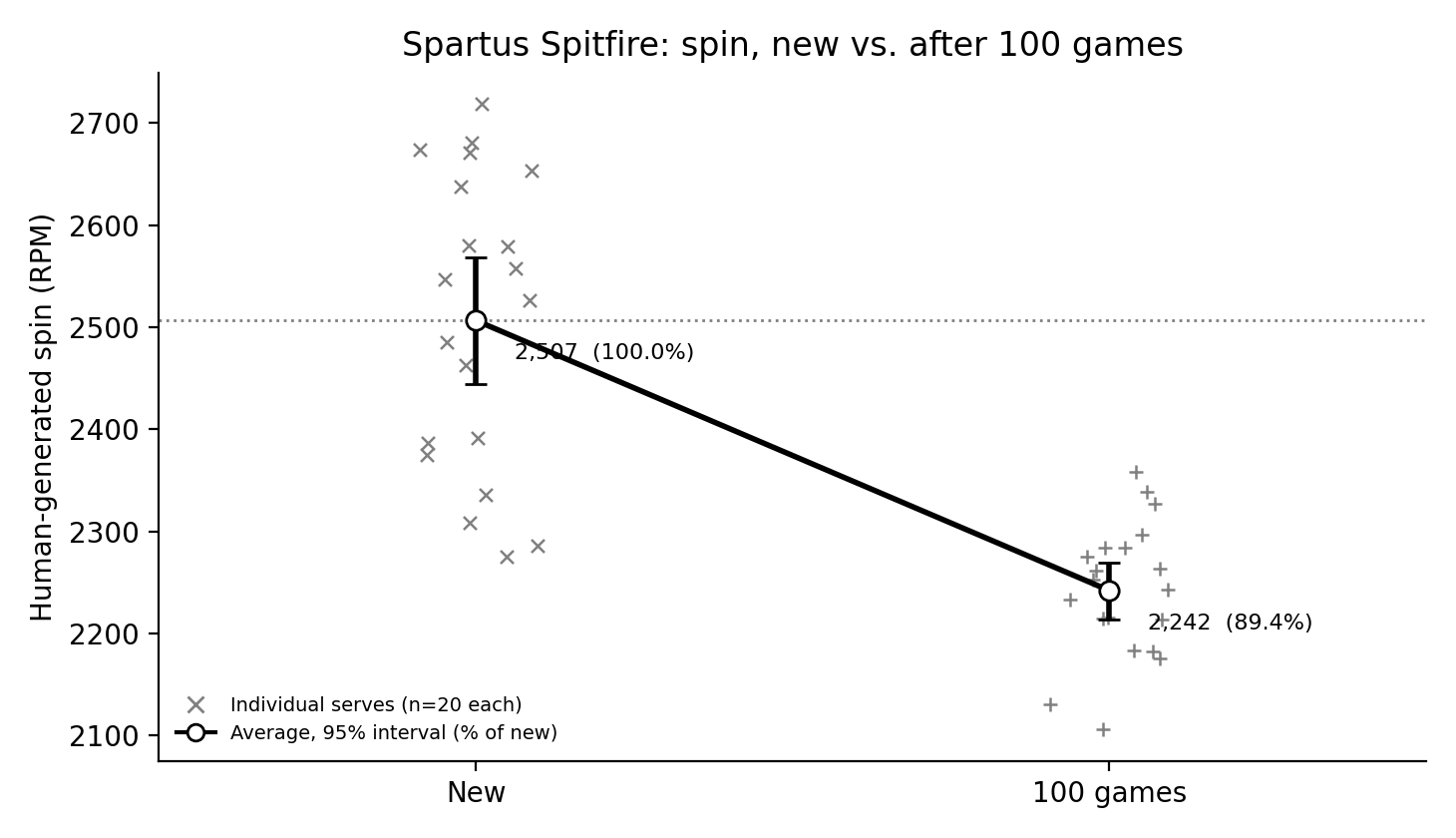
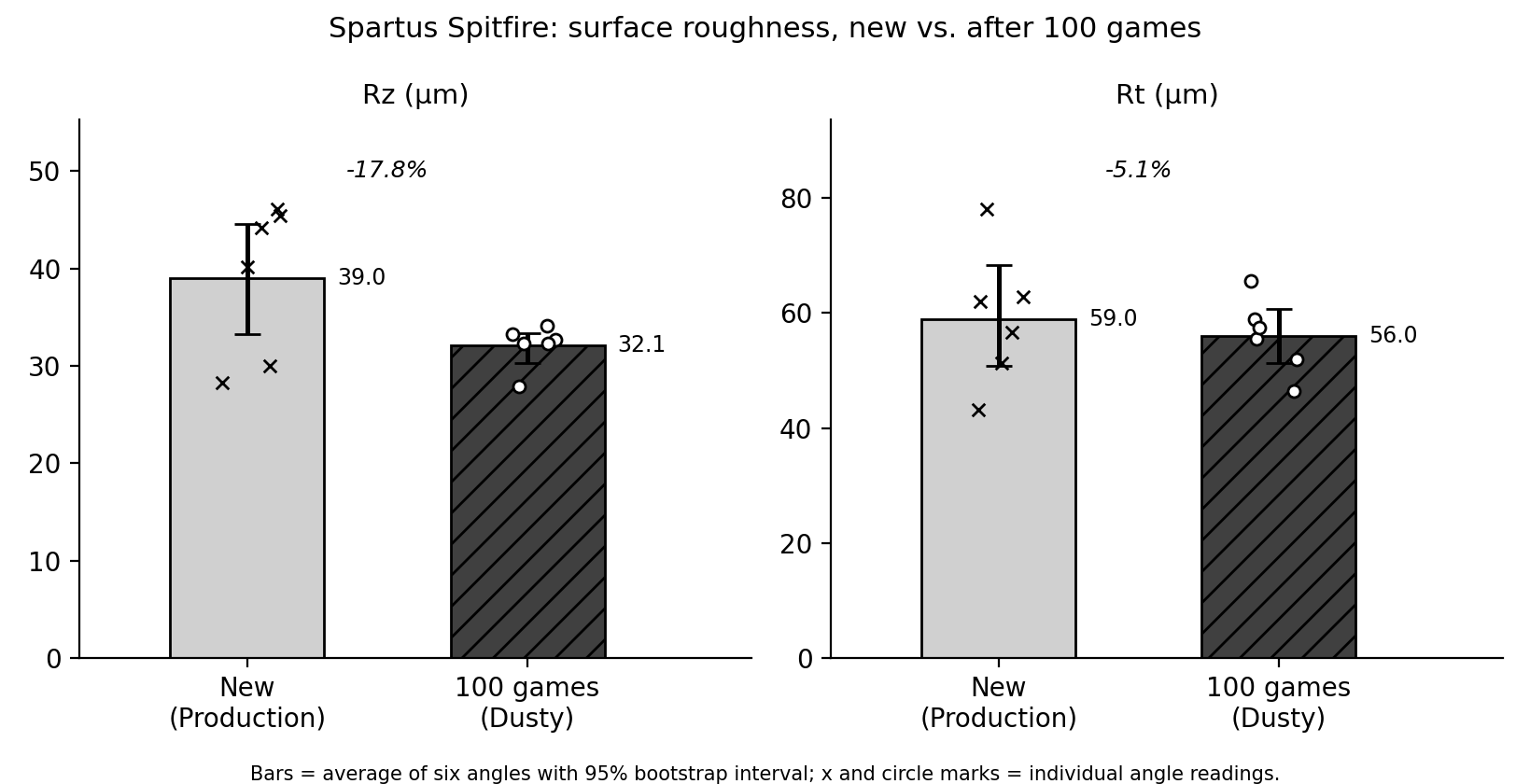
| Spartus Spitfire | New | After 100 games | Change |
|---|---|---|---|
| Spin (RPM, n=20 each) | 2,507 | 2,242 | -10.6% |
| Rz roughness (µm) | 39.0 | 32.1 | -17.8% |
| Rt roughness (µm) | 59.0 | 56.0 | -5.1% |
After 100 real games, the Spitfire lost 10.6% of its spin, which is a smaller loss than the 14.1% it showed in the cannon. That ended up being a pretty good real-world result for a paddle at this price. The surface was still textured after 100 games, with Rz of 32.1 and Rt of 56.0, and anything over 30 Rz and 50 Rt is a very aggressive texture. The spin averages above come from a separate set of 20 serves, so they will not match the spin number in the performance table exactly. This is one paddle, and 100 games is only the start. I will keep logging games.
Why the Flash FT Is My Favorite Vatic Shape
The V-Sol Tour comes in several shapes, and the Flash FT is the one I like the most. The reason is the starting swing weight. Stock, the Flash FT swings at 112.2, versus 115.2 on the Elongated, so there is more room to add perimeter weight before it starts to feel heavy.
I went with an MOI-style setup: 7.5 grams condensed at 9 and 3 o'clock. It made the paddle very forgiving, gave it noticeably more firepower, and it was still reasonably maneuverable to me. The numbers in this review are for the stock paddle, and I have not run this customized setup through my lab, so the extra firepower is what I felt on the court. That is the headline for the Flash FT: it is a great canvas for customizing.
On-Court Impressions
The Vatic V-Sol Tour and the Neonic NeoGrit FLX are similar in performance and in feel. The FLX has more top-end putaway power. The Tour is better in the control realm. I can see a player choosing either, depending on whether they want to finish points or build them.
The Spitfire sits off on its own in the feel map as a very hollow paddle, and it gives the impression of more firepower than the other two. Most people will perceive the Spitfire as the most powerful in this lineup, based more on feel than on actual output. The numbers back that up: the Spitfire has the lowest KewCOR (0.407) and the lowest Firepower score (50.7) of the three. I'm describing the elongated Spitfire here, but the Widebody is another story…
The Spitfire Widebody Hits Harder
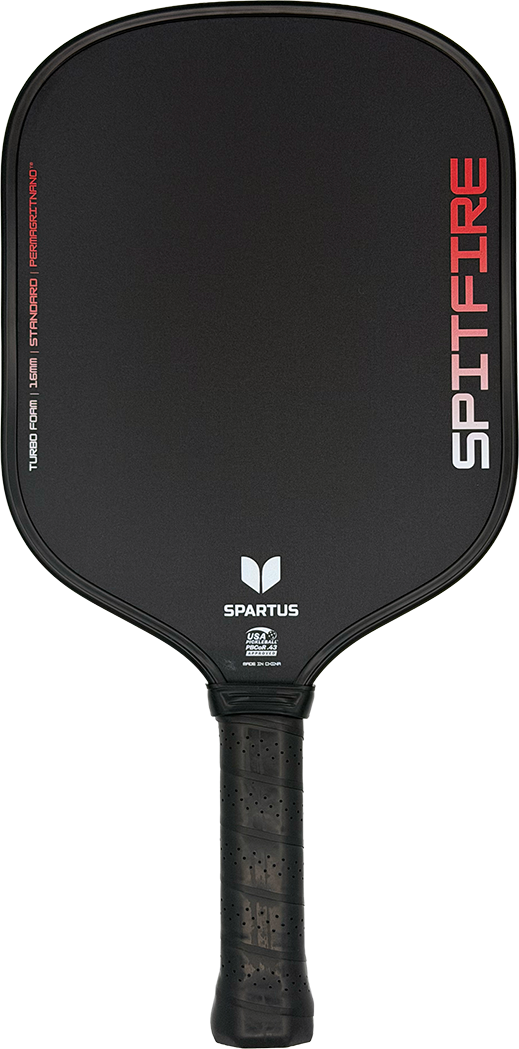
One thing I want to flag. The Spitfire Widebody has a large firepower discrepancy compared to the Elongated. It hits noticeably harder on the court, and the numbers agree:
| Spitfire Elongated | Spitfire Widebody | |
|---|---|---|
| KewCOR | 0.407 | 0.430 |
| Firepower (0 to 100) | 50.7 | 67.1 |
| Power: serve speed (scaled) | 53 | 65 |
| Pop: punch-volley (scaled) | 54 | 74 |
| Face deflection (lbs) | 34.0 | 43.2 |
| Swing weight | 116.2 | 107.9 |
| Spin (RPM) | 2,433 | 2,580 |
The Widebody has a higher KewCOR, higher face deflection, a swing weight about 8 points lower and higher spin. The gap in firepower is big enough that the Widebody would rank first in this group on firepower. I'm not sure if this is something about my unit or a real difference between the shapes, so take it as a data point, not a verdict.
Where These Fit in the Market
At about $110, these three are priced like budget paddles and measure like premium ones. All three have Elite spin, all three have Power-category KewCOR, and all three are USAP certified. Two of three held their spin in my cannon test, and the third did reasonably well after 100 real games.
Black Friday pricing, while it lasts: Spartus has the Spitfire at $90 from Nov 7 through Dec 4, and my code JOHNKEW stacks for 10% off that, which brings it to $81. Neonic's NeoGrit FLX launch price is $100 through Nov 30, or $90 with my code. I have not seen a sale on the Vatic V-Sol Tour, so it stays at $109.99 ($93.49 with my code). More offers are on my Black Friday deals page.
Who They're For and Not For
All three of these paddles are for budget-minded shoppers who want elite performance at a fraction of the cost. They are for players who don't mind playing with a paddle that others might not recognize, and who don't need an expensive paddle to serve as a status symbol. If that is you, any of the three will give you Elite spin, Power-category firepower and a durable grit for about $110.
Beyond that, it comes down to feel preferences, and the Feel Map above shows the split. The Spitfire sits far out on the hollow side, the NeoGrit FLX is the softest and most muted, and the V-Sol Tour lands right in between.
Choose the Spitfire
This one is for you if you like a more hollow, louder paddle. It gives the impression of the most firepower of the three, even though the Elongated has the lowest KewCOR (0.407). If you want the Spitfire's feel with the highest firepower, look at the Widebody instead. Skip it if you want a quieter, more muted feel, or if you want the longer one-year warranty (the Spitfire's is 6 months). The cannon result was a Moderate loss, but the 100-game real-world result was pretty good.
Choose the NeoGrit FLX
This one is for you if you want softer and more muted. The Swift is also the lightest and quickest of the group (7.6 oz, 110.2 swing weight, Hand Speed Index 77), and it has the most top-end putaway power of the three in my on-court impressions. Skip it if you want the more lively, hollow sound of the Spitfire, or a bit more control, which is where the Tour is better.
Choose the V-Sol Tour
This one is for you if you want something right in between: not as hollow and loud as the Spitfire, not as muted as the FLX. It is better in the control realm, and it has the highest Power (serve speed) score of the three elongated shapes. Skip it if you want the most putaway power (the FLX) or the most hollow feel (the Spitfire). The Flash FT is a great middle-ground option that will probably appeal to the widest audience in terms of performance and feel, and it is the best canvas for customizing.
These are not for you if you want a firm, crisp, stiff-hollow feel, if the brand name on the paddle matters to you, or if you need proven long-term durability. The cannon results are controlled lab tests, and real-world durability is still to be determined.
Final Thoughts
Soft-hollow power paddles have gone from none of the Power-category paddles I entered in Q1 to about 4 in 10 in Q4, and the budget end of the market is leading it. The Spitfire, V-Sol Tour and NeoGrit FLX are the best examples I have tested: Elite spin, great sweet spots, Power-category firepower, and a soft feel, at around $110.
I'm not choosing a winner yet. Call it a three-way tie at the moment. I need more time with the FLX and the Tour, and the Spitfire's real-world numbers need more games. A winner will be chosen in December for my 2026 paddle awards. Stay tuned. In the meantime, browse all my paddle reviews or see how these stack up in my head-to-head matchups.